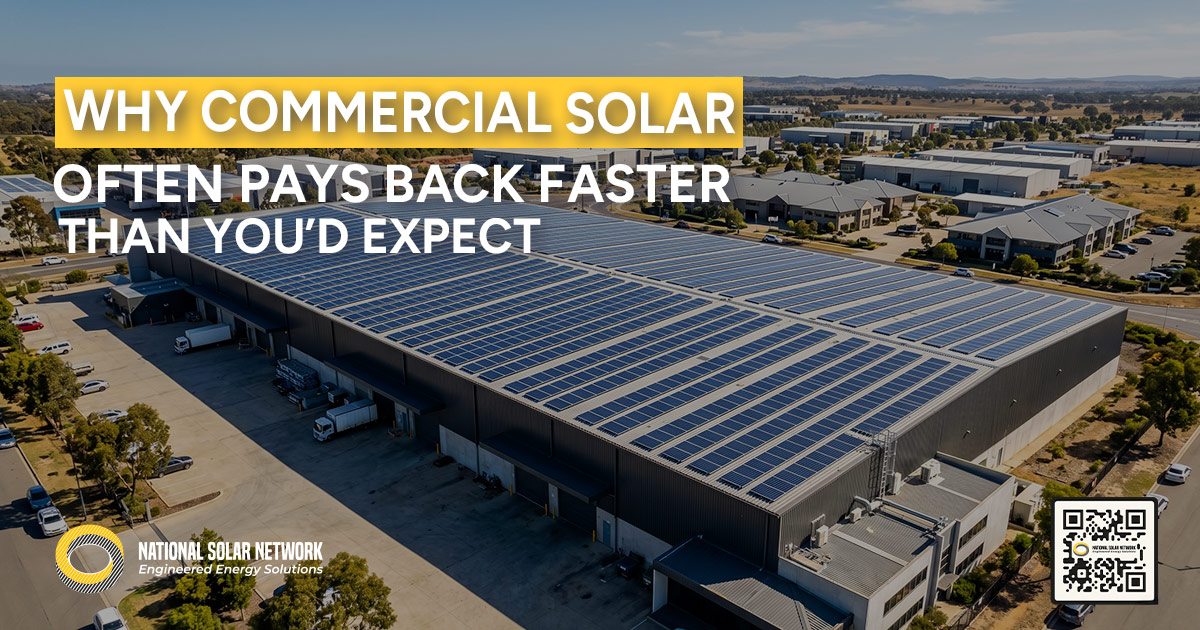
Most business owners approach commercial solar with the same question: how long before it pays for itself? The answer is usually shorter than expected, and the reason has little to do with system size or panel brand. It comes down to when your business uses electricity. For most commercial operations, peak consumption lines up almost exactly with peak solar generation hours. That alignment is what drives shorter payback periods, and understanding it will help you evaluate any quote you receive with a clearer head.
The Reason Commercial Payback Is Different from Residential
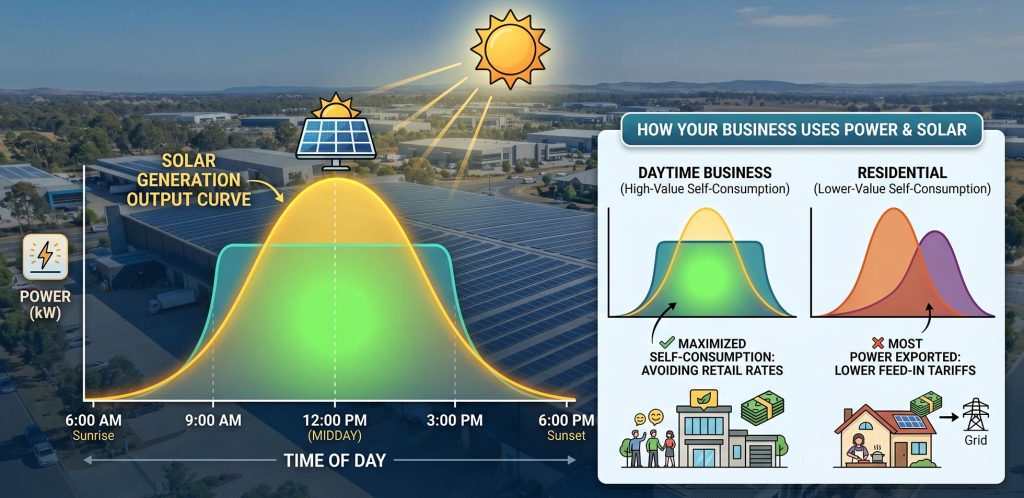
A residential solar system generates most of its power between roughly 9am and 4pm. In many households, the people who would use that power are not home during those hours. A significant share of what the system generates each day gets exported to the grid rather than consumed on-site.
That matters financially because exported solar is worth considerably less than solar consumed directly. In Queensland, the feed-in tariff paid for power sent to the grid typically sits between 5 and 10 cents per kilowatt-hour. The retail electricity rate that same household or business would otherwise pay is often three to four times higher.
A business running during the day changes that equation entirely. Offices, shops, manufacturers, and hospitality venues draw power continuously through the same hours that a solar system is generating. Instead of exporting that generation at a low rate, the business consumes it directly and avoids paying retail rates for it.
Every kilowatt-hour consumed on-site is worth more than the same kilowatt-hour exported. That gap, multiplied across a full year of operation, is what shortens the commercial solar payback period relative to a residential system of comparable size.
Which Businesses Are the Best Match for Fast Payback
The businesses that see the fastest payback share one characteristic: consistent electricity consumption during daylight hours. Operating profile matters more than the industry label.
Businesses that typically fit this profile well:
- Retail and hospitality. Cafés, restaurants, and shops run refrigeration, lighting, and kitchen equipment continuously from opening to close. Demand is high and predictable across the solar generation window.
- Manufacturing and light industrial. Production lines, compressors, and processing equipment draw large, sustained loads during operating hours. Systems sized to match that demand can achieve very high self-consumption rates.
- Cold storage and food processing. Refrigeration is a constant load, largely independent of staff activity. These operations often reach some of the highest self-consumption rates of any business type.
- Professional offices. HVAC, lighting, computers, and server infrastructure run consistently during business hours, with demand typically peaking in the late morning when solar output is near its highest.
- Agricultural and rural businesses. Irrigation pumps, processing equipment, and workshop machinery commonly run during daylight hours. Properties across Central Queensland also benefit from strong year-round solar irradiance.
Businesses with primarily evening or overnight operations will see longer payback periods. More of their generation is exported rather than consumed, which reduces the annual financial benefit.
Other Factors That Shape Your Payback Period
Self-consumption rate is the most important variable, but it does not work in isolation. Several other factors determine how quickly a commercial solar system recovers its cost.
| Factor | How it affects payback |
| Electricity tariff | Higher tariffs increase the value of every kilowatt-hour consumed on-site. Businesses paying 30 cents/kWh or more see faster payback than those on lower tariffs. |
| System size relative to demand | A system sized to your actual load avoids over-generation. Excess generation that cannot be consumed or stored earns only the feed-in tariff rate. |
| Roof orientation and shading | North-facing roofs in Queensland produce the most output across the day. East and west orientations shift the generation peak but can still perform well depending on when your consumption peaks. |
| Upfront system cost | Prices vary by system size, equipment quality, and installation complexity. A more accurate cost figure at assessment stage produces a more reliable payback estimate. |
| Feed-in tariff rate | The rate your retailer pays for exported power affects the value of generation you do not consume on-site. A higher rate improves returns on exported power marginally, but self-consumption remains the primary value driver. |
These factors compound. A business with high electricity tariffs, a well-oriented roof, and strong daytime consumption is likely to see a noticeably shorter payback period than a business where any one of those variables is unfavourable.
Government Incentives and What They Actually Reduce
Commercial solar systems in Australia are eligible for Small-scale Technology Certificates, known as STCs. These are generated at the point of installation based on the system’s size, location, and the number of years remaining in the STC scheme, which is scheduled to run until 2030. A SAA-accredited installer manages the creation and assignment of STCs as part of the standard installation process.
STCs reduce your upfront cost, not your payback period directly. But because they lower the net capital outlay, they reduce the total amount your system needs to recover before it breaks even. For a mid-size commercial system in Queensland, the STC benefit can represent a meaningful reduction in the installed price. Larger systems above 100kW may also be eligible for Large-scale Generation Certificates under a separate scheme. Eligibility and certificate value vary depending on system size and configuration. Our solar rebates guide for Queensland covers the current incentives in detail, including eligibility conditions and how STCs are applied at the point of sale.
What Payback Actually Looks Like: A Worked Example
The figures below are illustrative. They reflect a realistic scenario for a Queensland business with consistent daytime operations, but actual payback periods depend on the specific factors outlined above. Use this as a calibration tool, not a projection.
Scenario: 50kW system, net installed cost after STCs approximately $45,000
| High self-consumption (80%+) | Lower self-consumption (40%) | |
| Solar consumed on-site per year | ~70,000 kWh | ~35,000 kWh |
| Value at 30c/kWh (avoided retail cost) | ~$21,000 | ~$10,500 |
| Solar exported to grid per year | ~17,500 kWh | ~52,500 kWh |
| Value at 7c/kWh feed-in tariff | ~$1,225 | ~$3,675 |
| Total annual benefit | ~$22,225 | ~$14,175 |
| Estimated payback period | ~2 to 2.5 years | ~3 to 3.5 years |
The difference between these two scenarios is not the system, the panels, or the tariff. It is how much of the generated power is consumed directly. A business that runs consistently during the day captures the full retail value of nearly every kilowatt-hour its system produces. One that exports half its generation earns a fraction of that value for the exported portion, which extends the recovery timeline considerably.
How to Assess Your Own Business Before Getting a Quote
Before requesting a system design, it is worth spending an hour gathering a few basics. What you bring to an assessment directly affects how accurate and useful the outcome will be.
- Pull your last 12 months of electricity bills. Look for total consumption in kilowatt-hours, average daily usage, and the tariff rates you are currently paying. Note any seasonal variation, as this affects sizing decisions.
- Identify when your consumption peaks. If your bills include interval data, or if your retailer provides an online usage portal, check whether your peak demand falls within daylight hours. This is the single most useful piece of information for a solar assessment.
- Review your roof. Usable north-facing area, any shading from neighbouring structures or rooftop equipment, and the roof’s structural condition all affect what can be installed and at what cost.
- Consider battery storage separately. If your business has evening operations or wants backup capacity during outages, battery storage is worth discussing as a separate decision. It carries its own payback logic and should not be bundled into the solar calculation without a clear reason to do so.
- Ask your installer to size the system to your consumption, not your roof. A system larger than your load can absorb will export more than it saves, stretching your payback unnecessarily.
If you would like to work through these questions with a local installer, our commercial solar team in Rockhampton can review your bills and site conditions and give you a system assessment based on your actual usage profile.