If you’ve looked into home battery storage, you’ve probably come across the term energy arbitrage. It sounds technical, but the idea is straightforward. Whether it’s enough to justify the cost of a battery is a different question, and one worth answering carefully.
This article explains what energy arbitrage is, how it works in a residential setting, and what conditions need to be in place before it meaningfully contributes to a battery’s payback in Queensland.
The idea behind energy arbitrage
Electricity is not priced the same throughout the day. On a time-of-use tariff, you pay more per kilowatt-hour during peak periods, typically late afternoon and evening, and less overnight or during off-peak windows.
Energy arbitrage is the practice of using that price difference to your advantage. You store electricity when it’s cheap, then draw from that stored energy when grid prices are at their highest. The wider the gap between those two prices, the more value each charge/discharge cycle delivers.
In a home setting, the battery is the tool that makes this possible.
How a home battery makes it work
The process follows a straightforward cycle.
- Charge during low-cost periods. The battery fills during off-peak hours, either from your solar panels during the day or from the grid overnight when rates are lower.
- Store until prices rise. The battery holds that energy, managed by the system’s software, which monitors your tariff schedule and usage patterns to decide when to hold and when to release.
- Discharge during peak hours. When grid rates climb in the late afternoon or evening, the battery powers your home instead of the grid. You’re consuming electricity you bought cheaply, at a time when the alternative would cost significantly more.
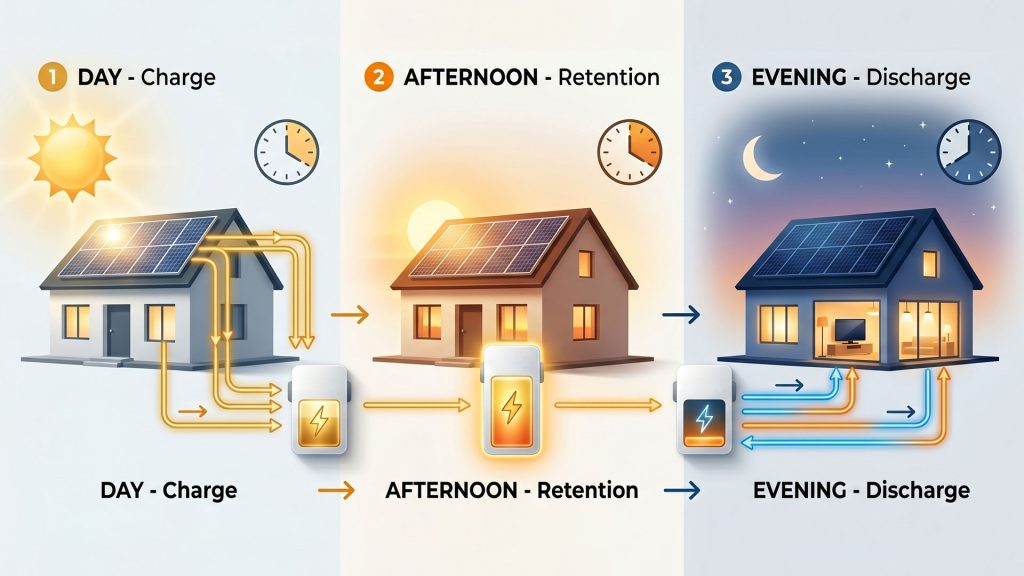
The financial gain comes from that price differential applied consistently across hundreds of cycles over the system’s life.
Time-of-use tariffs: why your electricity plan matters more than your battery
A home battery cannot create value from arbitrage on a flat-rate electricity plan. If you pay the same price per kilowatt-hour regardless of when you use it, there is no price gap to exploit. The battery still has value for backup and solar self-consumption, but the arbitrage case disappears entirely.
This distinction matters because many households in Queensland are still on flat-rate tariffs without realising it.
| Plan type | Peak rate | Off-peak rate | Arbitrage potential |
| Flat rate | Same all day | Same all day | None |
| Time-of-use | Higher (afternoon/evening) | Lower (overnight or solar hours) | Meaningful, depends on gap size |
Before a battery is sized for arbitrage, your current tariff needs to be confirmed. If you’re not on a time-of-use plan, the calculation either changes or the strategy doesn’t apply until you switch. Some retailers in Queensland offer TOU tariffs, but eligibility and rates vary by network area and meter type.
Solar changes the equation
A battery purchased without solar relies on cheap grid energy to charge. In most Australian markets, that means overnight off-peak rates, which are lower than peak but still a cost. The price differential you’re working with is real, but it is somewhat compressed.
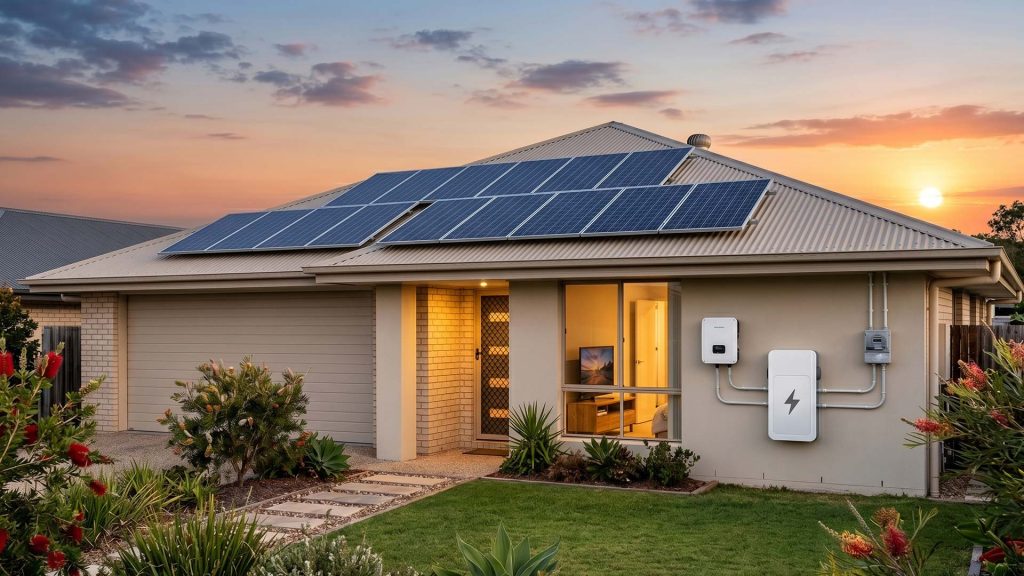
When solar is part of the system, the arbitrage case becomes more compelling. Your panels generate during the middle of the day, when household consumption is usually lowest. That surplus charges the battery at no grid cost. In the evening, when household demand rises and grid rates peak, the battery discharges energy that was essentially free to store.
If you’re considering adding a battery to an existing solar setup, our residential solar and battery storage page covers how systems are sized and integrated in Central Queensland.
Feed-in tariffs, the rate your retailer pays for excess solar exported to the grid, have declined significantly in Queensland over recent years. In that environment, keeping solar generation within the home through battery storage often delivers more value than exporting it. Arbitrage and self-consumption overlap here: both strategies favour using your own stored energy rather than trading with the grid. For a current breakdown of what financial support is available, our Queensland solar rebates guide covers the detail.
What limits the return
Several variables determine how much value energy arbitrage actually delivers for a specific household. Understanding them prevents overestimating the outcome.
- Battery cost. The upfront cost of a quality home battery system in Australia currently sits in a range that requires several years of accumulated savings to recover. Arbitrage contributes to that payback, but it rarely accelerates it to a short timeframe on its own.
- Cycle depth and degradation. Battery capacity declines gradually with use. Manufacturers typically quote capacity retention at 70 to 80 percent after a set number of cycles or years. A battery operating at reduced capacity delivers proportionally less arbitrage value over time.
- Tariff gap size. Not all TOU plans are equal. A plan with a modest difference between peak and off-peak rates generates less arbitrage value than one with a wider spread. The actual savings figure is tied directly to this gap.
- Household consumption patterns. A household that uses most of its electricity during off-peak hours, for example a home where no one is present in the evenings, extracts less peak-hour value from the battery.
- Export rate changes. Retailers can and do revise feed-in tariff rates. If the export rate increases, the case for keeping energy in a battery rather than exporting it may shift. The calculation is not static.
What the numbers can look like
To illustrate how the savings logic works, consider a household in Central Queensland on a time-of-use plan with a peak rate of around 45 cents per kilowatt-hour and an off-peak rate of around 20 cents. A 10 kWh battery that fully cycles once per day captures roughly 10 kWh of that price difference.
In this scenario, each full cycle avoids approximately $2.50 in peak-rate consumption compared to what off-peak charging cost. Over 300 cycles per year, that represents around $750 in avoided grid costs annually, depending on how completely the battery cycles and how consistently the household draws from it during peak hours.
That figure is conditional on tariff rates staying consistent, the household actually consuming during peak hours, and the battery maintaining usable capacity. It does not account for the cost of the battery itself, installation, or any shifts in retailer pricing.
The point of this illustration is not to project a return. It is to show that the arithmetic is straightforward once you know your own tariff rates and usage pattern. Those inputs are specific to each household and are part of what a proper assessment should clarify.
Is energy arbitrage the right reason to buy a battery?
Arbitrage is a legitimate and quantifiable source of value from a home battery. Whether it alone justifies the investment depends on where your household sits relative to a set of conditions.
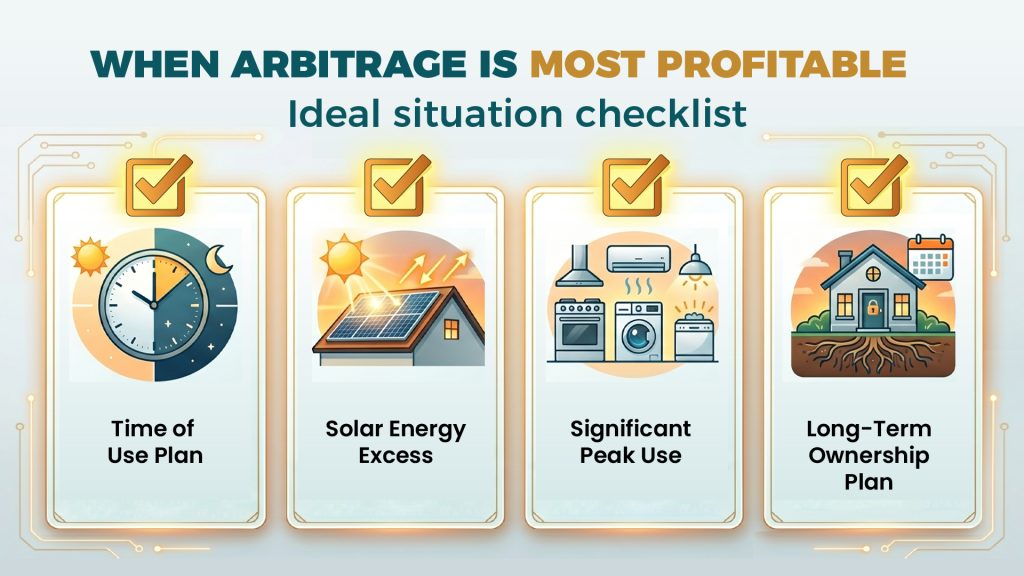
The case is stronger when:
- You are already on a time-of-use tariff, or can switch to one with a meaningful peak/off-peak spread
- You have solar panels generating during the day and a consistent evening demand to discharge into
- Your household uses significant energy during peak hours, such as cooking, air conditioning, and appliances running from late afternoon onward
- You are planning for a long-term hold on the property
The case is weaker when:
- You are on a flat-rate plan and either cannot or do not intend to switch
- Your solar system is already undersized relative to household demand, leaving little surplus to charge the battery
- Your peak-period consumption is low or irregular
- You are primarily motivated by backup power during outages, which is a different use case that warrants separate evaluation
Most households that benefit from battery storage draw value from a combination of factors: arbitrage, increased solar self-consumption, and backup capability. Treating arbitrage as the single justification concentrates the calculation on one variable and can lead to unrealistic expectations. Treating it as one part of a broader value picture tends to produce a more accurate assessment.
Getting the most from battery storage in Queensland
The right battery size, matched to your actual consumption profile and combined with a correctly sized solar system, gives you the best platform for arbitrage and self-consumption. Undersizing the battery limits how much peak-period energy you can displace. Oversizing it means paying for capacity you rarely fill.
Tariff selection is equally important, and it’s worth reviewing before or alongside a battery decision. In some cases, switching plans changes the financial outcome more than the choice of battery brand.
A site assessment that looks at your roof, your usage data, your current tariff, and your budget is the starting point for a realistic answer. The numbers that matter are yours, not an average. If you’d like to understand what a battery system could look like for your home in Rockhampton or the surrounding area, take a look at our solar battery storage page or get in touch for an assessment.